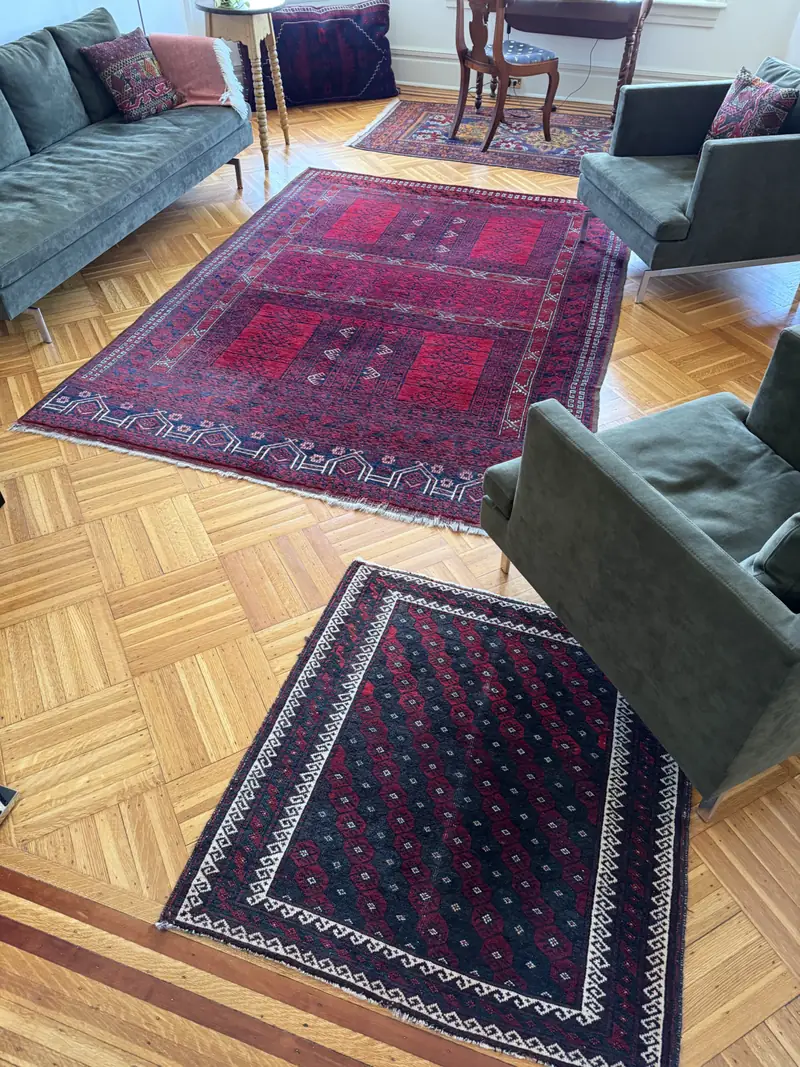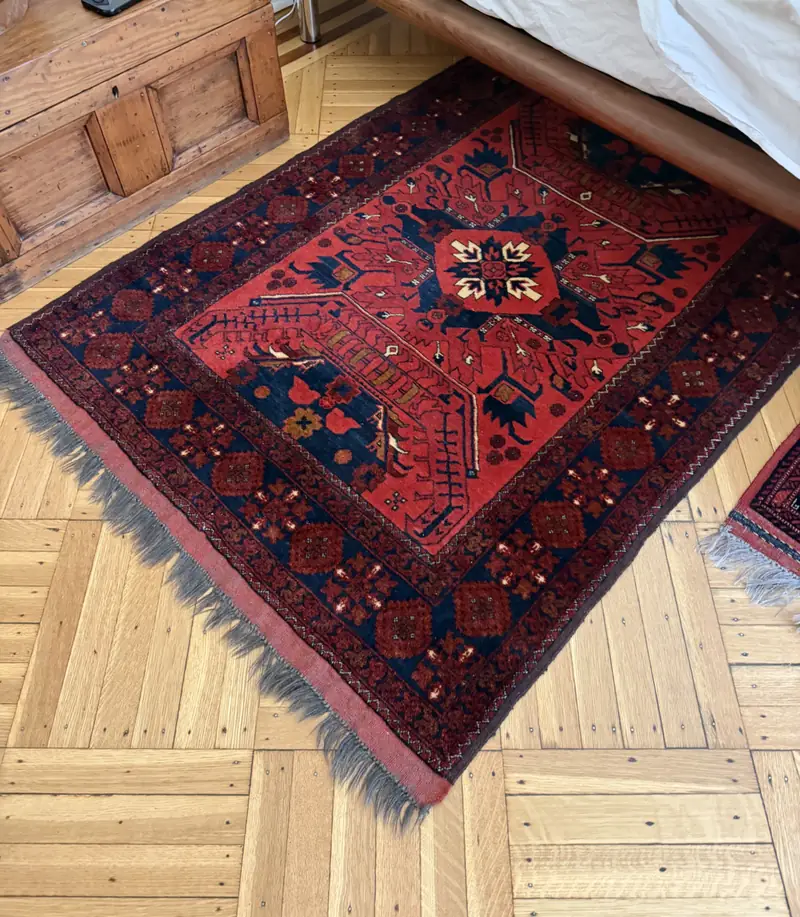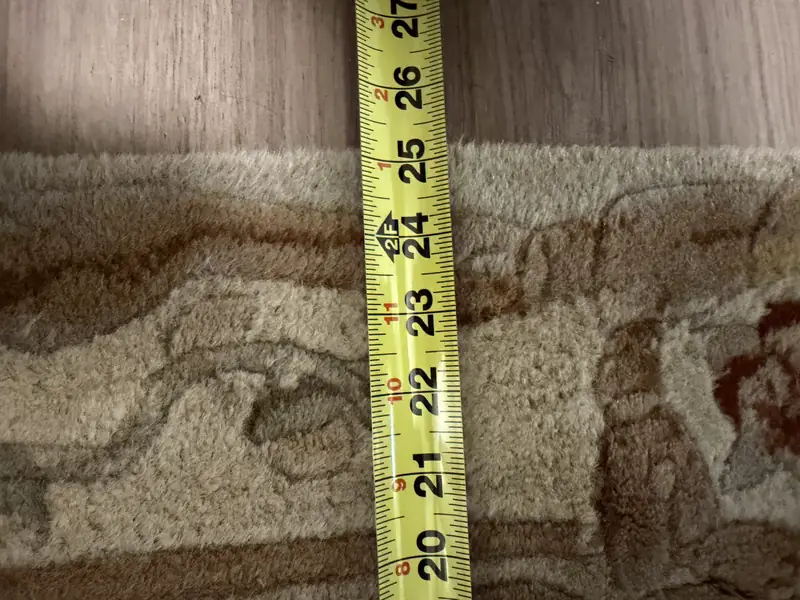
Moths favor wool rugs that sit undisturbed in low light, so check under furniture and along walls first. Look for bare patches worn to the foundation, sandy casings or webbing in the fibers, and small larvae on the back. Any of these means the rug needs a closer look.
Why moth damage starts in the dark corners
Wool moths do not eat dye or finished fabric, they eat the keratin in wool fiber, along with skin cells, hair and food residue caught in the pile. What they need most is to be left alone. A rug that gets walked on, vacuumed and exposed to light disturbs larvae and interrupts feeding, so damage rarely starts in the middle of a living room. It starts under a sofa, behind a console table, beneath a bookcase, along a wall under drapery, or in a guest room that goes weeks between visits. Check those areas first, and check them with a flashlight rather than overhead light.
Bare patches along walls and under furniture
Ordinary wear fades a rug evenly, in the path people walk. Moth damage looks different. It shows up as an irregular bare patch, sometimes no bigger than a coin, sometimes spreading to a hand sized area, with the pile gone right down to the foundation threads. The edges of the patch are ragged rather than gradually thinned. If you find a bare spot in a corner that gets no foot traffic, that is the pattern to take seriously, not ordinary wear.
Sandy casings and webbing in the pile
Part the pile in the suspect area with your fingers and look closely. Moth larvae leave behind casings that look like fine sand or grit, a mix of shed skin and droppings, and they often spin small silken tubes or patches of webbing that mat the fibers together. Run your hand over the spot. A gritty feel where the rest of the rug feels clean is worth investigating further, even if you cannot see a patch yet.
Larvae hiding on the back of the rug
Flip the rug over and check the back, especially along the edges, in the corners, and around the fringe. Larvae are small, cream colored and easy to miss against wool foundation threads, but they tend to cluster where the weave is tightest and darkest. If the rug has been stored folded or rolled, unroll it fully and check the folds, since moths favor the still air inside a rolled rug as much as they favor a dark room.
What to do the day you find damage
Do not shake the rug out indoors and avoid aggressive vacuuming over the damaged area, since both actions can scatter eggs and larvae to other rugs, upholstery or closets in the room. If you need to move the rug, roll it with the damaged area on the inside and bag it if you can. Vacuuming alone will not remove eggs set deep in the pile or foundation, so the next step is a full cleaning paired with a moth treatment, which clears existing larvae and eggs and then treats the fibers. If the rug is wool or a wool blend, wool rug cleaning handles the fiber correctly alongside the treatment, and if it is a hand knotted piece, handmade rug cleaning accounts for how the specific weave and dyes respond before any work starts.
Reducing the conditions that invite moths
Once the active damage is addressed, change the conditions that let it start. Rotate rugs every few months so no section sits undisturbed for long, move furniture off a rug periodically to expose the covered area to light and air, and vacuum both the front and the back on a regular schedule. Moths are not fussy about one rug in one room. Check wool sweaters, blankets and other natural fiber textiles stored nearby, since an infestation often moves between them.
When the damage is more than cleaning can fix
Cleaning and treatment stop active feeding, they do not rebuild pile that is already gone. A small bare patch may blend in once the rug is clean and the surrounding fibers are restored to their natural condition. A hole that has eaten through the foundation threads is a structural problem, and that calls for a conservator's reweaving rather than cleaning alone. What a rug needs depends on how far the damage has gone, which is why an assessment comes before any plan is set.
Questions people ask
Can I vacuum a rug with moth damage myself?
Light vacuuming away from the damaged area is fine, but avoid running the vacuum directly over a suspected patch, since it can scatter eggs and larvae rather than remove them. Have the affected area looked at before cleaning it yourself.
Do moths only damage wool rugs?
They target wool and other natural animal fibers such as silk blends, since those contain the keratin larvae feed on. Synthetic fiber rugs are rarely a food source, though moths may still nest in dust and debris trapped in any rug.
How fast does moth damage spread?
It depends on temperature, humidity and how undisturbed the area stays. Warm, still, dark conditions let larvae feed and multiply faster, which is why a damaged area left unchecked in a rarely used room tends to grow over time.
Can a bare patch from moth damage be repaired?
Small areas sometimes improve once the rug is cleaned and the surrounding pile is restored. Larger holes that reach the foundation threads usually need reweaving by a conservator, since cleaning cannot rebuild missing structure.
Should I throw away a rug with moth damage?
Not necessarily. Many rugs recover well once the infestation is treated and the cleaning addresses the fiber and construction. Whether the rug is worth treating further depends on the extent of the damage, which an assessment can tell you.
Arrange a pickup
Pickup and return are free in all five boroughs, Westchester, Long Island and New Jersey. Arrange a pickup, get a quote or call (888) 789-7001. A request is not a confirmed appointment: our team calls you to confirm the details.