Turn the rug over. A hand-knotted rug shows the same pattern on the back as the front, with individual knots visible and small irregularities in the weave. A hand-tufted rug has a plain cloth backing glued in place. A machine-made rug has a uniform woven or felted backing with no knots at all.
Turn the rug over and look at the back
This is the fastest check and the most reliable one. On a hand-knotted rug, the design on the back mirrors the front, row by row, because each knot is tied by hand around the foundation threads. Run a finger across the back and you can feel the individual knots, and the pattern is rarely perfectly even, since no two knots are tied with exactly the same tension. A hand-tufted rug shows none of this. The back is a flat cloth backing, usually canvas or scrim, coated with a layer of latex that holds the pile in place. A machine-made rug has a backing that is woven or felted as part of the manufacturing process, with a repeating pattern that looks identical however many times you check it.
Check the fringe and the edges
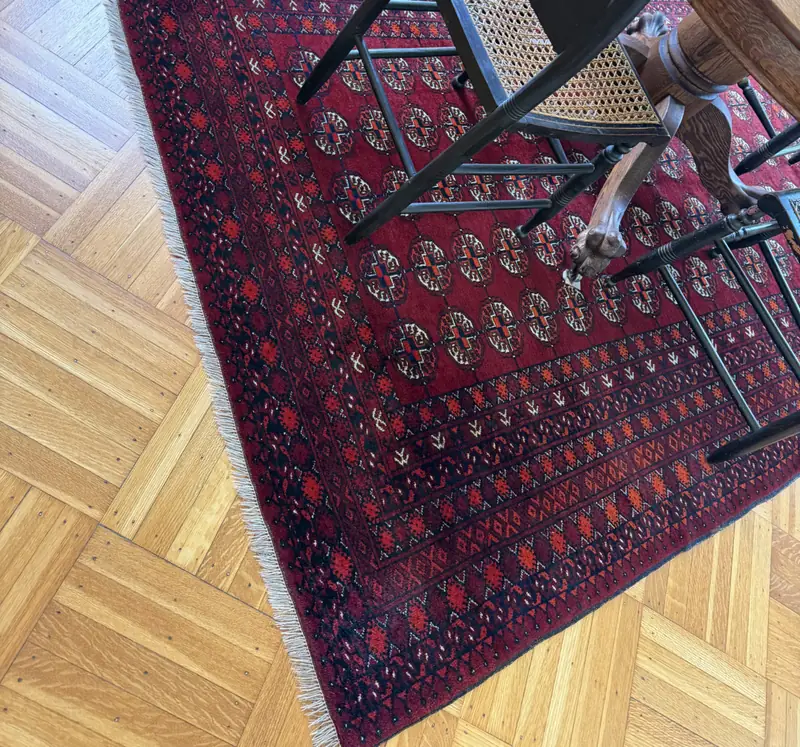
On a genuine hand-knotted rug, the fringe is not sewn on. It is the exposed end of the same foundation threads, the warp, that run the length of the rug. Pull gently and you will feel that the fringe continues into the body of the rug rather than stopping at a seam. The edges, called the selvage, are usually overcast by hand in wool or cotton thread, and you can see the slight unevenness of hand work under close light.
A hand-tufted or machine-made rug often has fringe sewn on as a separate piece after the rug is finished. Look at the point where the fringe meets the pile: a clean seam or a line of stitching is a clear sign the fringe was added rather than woven in. Machine-made edges are often serged, a tight, even overlock stitch in synthetic thread, which hand work never quite matches.
Spot a tufted rug by its cloth backing and latex
Hand-tufted rugs are made with a tufting gun that pushes yarn through a stretched cloth backing from the front, and a layer of latex adhesive is then spread on the back to lock the tufts in place before a second cloth layer is sometimes added. The giveaway is that second layer: a soft, flexible cloth backing, often with a faint rubbery smell when new, and a texture closer to a mat than a woven rug. Over time latex can dry out, crack or yellow, and in humid conditions it can soften and smell. This construction detail matters for cleaning because heavy wetting can loosen the latex bond between pile and backing, a problem called delamination, where the pile starts to separate from the backing in patches.
What machine-made construction looks like
Machine-made rugs are woven on power looms that produce a backing and pile in one continuous process, which is why the pattern repeats with total precision and the back looks identical across the whole rug. Fibers are often synthetic, polypropylene, nylon or polyester, though some machine-made rugs use wool or wool blends. There is no fringe woven into the structure, so any fringe present was sewn on afterward. Dyes vary by manufacturer and fiber, and synthetic dyes generally hold color well, though some older or lower grade machine-made rugs still bleed when wet, so a hidden-corner test still matters.
Why construction decides how a rug can be cleaned
A hand-knotted wool or silk rug, with knots tied directly around a cotton or silk foundation, can usually take a full hand wash, since the structure is designed to be saturated and dried flat. Handmade rug cleaning is built around that assessment, checking fiber, dye and foundation before choosing a method. Silk rug cleaning in particular relies on low-moisture techniques, since silk fibers lose strength and can water-stain when soaked.
A hand-tufted rug needs a different approach because of the latex backing. Cleaning has to control moisture carefully so the glue bond is not compromised, and aggressive extraction or prolonged soaking is avoided. A machine-made rug is often more forgiving of routine cleaning, since synthetic fibers resist staining and the backing is sealed into the weave, but colorfastness and fiber type still need to be checked before any wet method is used. Construction is one of the first things assessed, alongside fiber, dyes and condition, before a cleaning method is chosen.
When construction is hard to read
Heavy wear flattens the pile and can make knots harder to feel on the back, and old repairs sometimes patch a damaged section of a hand-knotted rug with machine-made fringe or reinforced backing, which confuses the picture. A rug with wool pile, cotton fringe sewn on later and a patched corner can show mixed signals even to an experienced eye. Antique rug cleaning starts with that same close look at the back, the fringe and the edges, because preservation decisions depend on knowing exactly how the rug was built before any cleaning agent touches the fibers.
If you are still unsure after checking the back, the fringe and the edges, it is worth having the rug looked at before attempting to clean it at home. A wrong guess about construction, particularly mistaking a latex-backed tufted rug for a hand-knotted one, can lead to a cleaning approach that does more harm than the soil it was meant to remove.
Questions people ask
What is the quickest way to tell if a rug is hand-knotted?
Turn it over. If the pattern on the back mirrors the front and you can feel individual knots, it is hand-knotted. A flat cloth backing means it is tufted, and a uniform woven backing with no knots means machine made.
Why does my tufted rug smell like rubber?
That smell usually comes from the latex adhesive that holds the tufted pile to its cloth backing. It is more noticeable when the rug is new or when it gets damp, and it can mean extra care is needed with moisture during cleaning.
Can a sewn-on fringe mean the rug is fake or low quality?
Not necessarily. Sewn-on fringe is standard on hand-tufted and machine-made rugs and does not by itself say anything about the quality of the pile or the dyes. It does mean the rug was not hand-knotted.
Is it safe to deep clean a hand-tufted rug at home?
Approach it carefully. Heavy wetting can loosen the latex backing and cause the pile to separate from the cloth underneath, so low-moisture methods and quick drying matter more than on a hand-knotted wool rug.
My rug is worn and I cannot tell the construction. What should I do?
Heavy wear and old repairs can hide the usual signs on the back, the fringe and the edges. When construction is unclear, it is worth having the rug assessed before any cleaning method is chosen.
Arrange a pickup
Pickup and return are free in all five boroughs, Westchester, Long Island and New Jersey. Arrange a pickup, get a quote or call (888) 789-7001. A request is not a confirmed appointment: our team calls you to confirm the details.